October 8, 2026
The Robot Revolution Is Real — Just Not on the Timeline Tech Billionaires Are Selling You
Elon Musk says humanoid robots will be on sale to the public by the end of 2027. Jensen Huang predicted they would match human-level ability this year. Marc Andreessen called robotics potentially…
The Robot Revolution Is Real — Just Not on the Timeline Tech Billionaires Are Selling You
Elon Musk says humanoid robots will be on sale to the public by the end of 2027. Jensen Huang predicted they would match human-level ability this year. Marc Andreessen called robotics potentially "the biggest industry in the history of the planet." Before you restructure your business around robotic automation, MIT Technology Review has a sobering message: the gap between the demo reel and the factory floor is enormous, and small business owners should understand exactly what that means for their planning horizon.
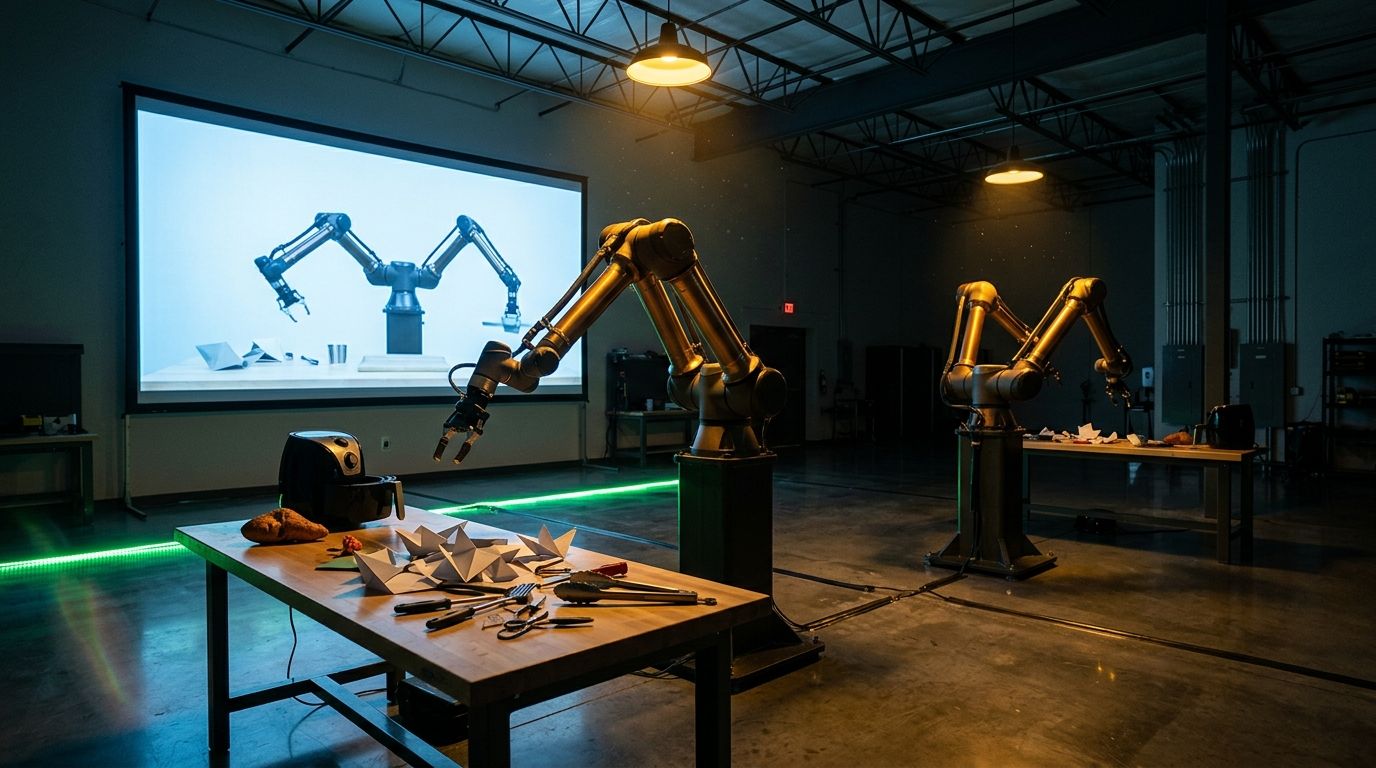
The current state of AI-powered robotics is genuinely impressive, just nowhere near what the headlines imply. Google DeepMind's most advanced robotics system, Gemini Robotics, controls a dual-arm rig called ALOHA 2 using a vision-language-action model, or VLA, that can pack a passable lunchbox, pick up snow peas with kitchen tongs, and fold origami. San Francisco startup Physical Intelligence, known as PI, has developed a generalist robotics model called π0.7 that showed the first real signs of what researchers call "compositional generalization," meaning it could attempt a task it had never been specifically trained on, loading a sweet potato into an air fryer, by recombining fragments of prior learning. It did not fully complete the task. Those fragments of capability are meaningful milestones, and they represent years of serious scientific effort. But Marc Raibert, founder of Boston Dynamics, put the commercial reality plainly: "70% success is like it doesn't work."
The data on where the industry actually stands is clarifying. Of the roughly 15,000 humanoid robots shipped globally in 2025, nearly 90% came from Chinese manufacturers, led by Unitree, whose entry-level humanoid costs under $6,000. Buyers were overwhelmingly corporate labs, academic institutions, and state-owned enterprises, not businesses putting robots to work on general tasks. Agility Robotics has hundreds of units in trial deployments with companies like Amazon and GXO Logistics, but CEO Jonathan Hurst says those robots are doing simple jobs such as moving bins and totes. Tesla's Optimus, which Musk said in May 2025 would number in the "thousands" working on factory floors by year's end, had by January of this year reached only "some robots doing simple tasks in the factory." Yann LeCun, one of the acknowledged founding figures of modern AI, was direct at Davos: "None of those companies building humanoid robots has any idea how to make those robots smart enough to be useful."
For small and mid-size business owners, this matters in two concrete ways. First, if you are in a sector where robotics vendors are pitching you on automation timelines, apply the same scrutiny you would to any vendor making extraordinary claims. The robots being demoed on stage are frequently remote-controlled or scripted. The 1X Neo home robot, available for preorder at $20,000, still requires a remote human operator for most tasks, meaning a person would need access to your home or facility through the robot's cameras to make it function. Hurst himself estimates it will be 10 years before robots are genuinely doing useful autonomous work in homes. Factory and logistics environments will move faster, but even there, the capabilities are narrow, specific, and hard-won.
Second, and more strategically, the AI that is transforming business right now is not the AI in robotics labs. It is the AI already embedded in your marketing, customer acquisition, content production, analytics, and sales automation. The breakthroughs powering VLAs and world models are downstream cousins of the large language models and vision-language models already available to you through tools your team can use today. The robotics story is a useful reminder that AI capability is real but uneven. The parts of AI that are mature, reliable, and commercially deployable are the parts built on language and data, not the parts still struggling to fold laundry without falling over.
This week, look at where your team is still doing repetitive, language-based work at scale: writing product descriptions, responding to lead inquiries, segmenting email lists, generating ad copy variants, summarizing customer feedback. Those are the tasks where AI delivers the 95%-plus reliability that actually moves your business forward, not 70%, not with a human puppeteer backstage. Pick one of those workflows and identify a specific AI tool or integration that could take over even part of it by Friday.
The robotics revolution will arrive eventually, but the AI marketing revolution is happening right now, and the businesses growing fastest are the ones acting on what is deployable today rather than waiting for the demo reel to become reality.
Originally inspired by: AI breakthroughs in robotics won't change your life any time soon (https://www.technologyreview.com/2026/10/08/1145923/ai-breakthroughs-in-robotics-wont-change-your-life-any-time-soon/) See how Leads to Conversion can help you put the AI tools that actually work to work for your business today. Get your free AI audit
Your turn
What is your traffic actually doing?
Send us your details and we will come back with a short, specific read on what your traffic, your pages and your pipeline are doing today — and the first three things we would change. A real person reads every submission, and you get the read whether or not we ever work together.