October 29, 2026
Google's AI Search Revenue Problem Is a Wake-Up Call for Every Small Business Owner Running Ads
Google just lost up to ten percent of its market value in a single day. Not because the company is struggling overall, but because one number told investors something they had feared for years…
Google's AI Search Revenue Problem Is a Wake-Up Call for Every Small Business Owner Running Ads
Google just lost up to ten percent of its market value in a single day. Not because the company is struggling overall, but because one number told investors something they had feared for years: AI-powered search may be quietly eating the very ad revenue that built the most dominant marketing platform in history.
In its third quarter 2026 earnings report, Google revealed that search revenue grew 12 percent, landing at $63.4 billion. That sounds strong until you learn that analysts had expected 15 percent growth. The miss triggered a stock drop of as much as ten percent. On the earnings call, Google executive Philipp Schindler stated directly that "the strong growth in AI mode queries had an impact because of the lower monetization," naming it as a contributing factor to the shortfall. In plain language: more people are using Google's AI mode to search, and those queries are generating less ad revenue than the traditional search clicks that small businesses have been bidding on for years.
The scale of what is happening inside Google is worth understanding. CEO Sundar Pichai disclosed that the Gemini app has now reached one billion users, calling it the fastest-growing product in the company's history. Google's own AI model APIs are processing nearly 32 billion tokens per minute, more than four times the volume from a year earlier. Meanwhile, Google Cloud more than doubled its revenue year over year, hitting $30.7 billion, up 103 percent from $15.2 billion in Q3 2025, with operating margins rising from 23.7 percent to 36.2 percent. Google is also spending at a historic pace, with capital expenditures of $51.4 billion in the third quarter alone and a full-year 2026 forecast of $195 billion to $205 billion, with even higher spending planned for 2027. The company is clearly betting its future on AI infrastructure, not on the ad auction model that most small businesses have relied on.
What does this mean for small business owners who depend on Google Ads to generate leads? The core issue is structural. When a potential customer types a question into Google's AI mode and gets a direct, conversational answer, they may never click on an ad. The traditional search funnel, where someone searches, scans results including paid ads, clicks, and converts, is being compressed. Google acknowledged this tension while also noting that its annual search query growth rate hit its highest level in five years. More searches are happening, but fewer of them are producing the ad clicks and conversions that small business ad budgets are built around.
For service businesses, local retailers, and B2B providers who have built their lead generation on paid search, this is a moment to diversify rather than panic. Google is already working to expand its AI mode ad program internationally, which means ads will eventually follow the AI queries. But the format, the buyer behavior, and the conversion paths will be different. An AI-mode searcher who gets an answer directly from Google is further up the funnel and less ready to click and buy than someone who searched with traditional intent. Your messaging, landing pages, and offers will need to match that different mindset.
There is also a significant opportunity hiding inside this shift. Google Cloud chief Thomas Kurian stated that AI agents in production require more compute, more storage for agent memory, and more database capacity for reasoning. Companies that learn to build and deploy AI agents now are positioning for the infrastructure wave Google and others are betting billions on. For small businesses, this means exploring AI-driven tools for customer service, lead follow-up, and content personalization, not just paid search, can give you a durable edge regardless of how the search ad market evolves.
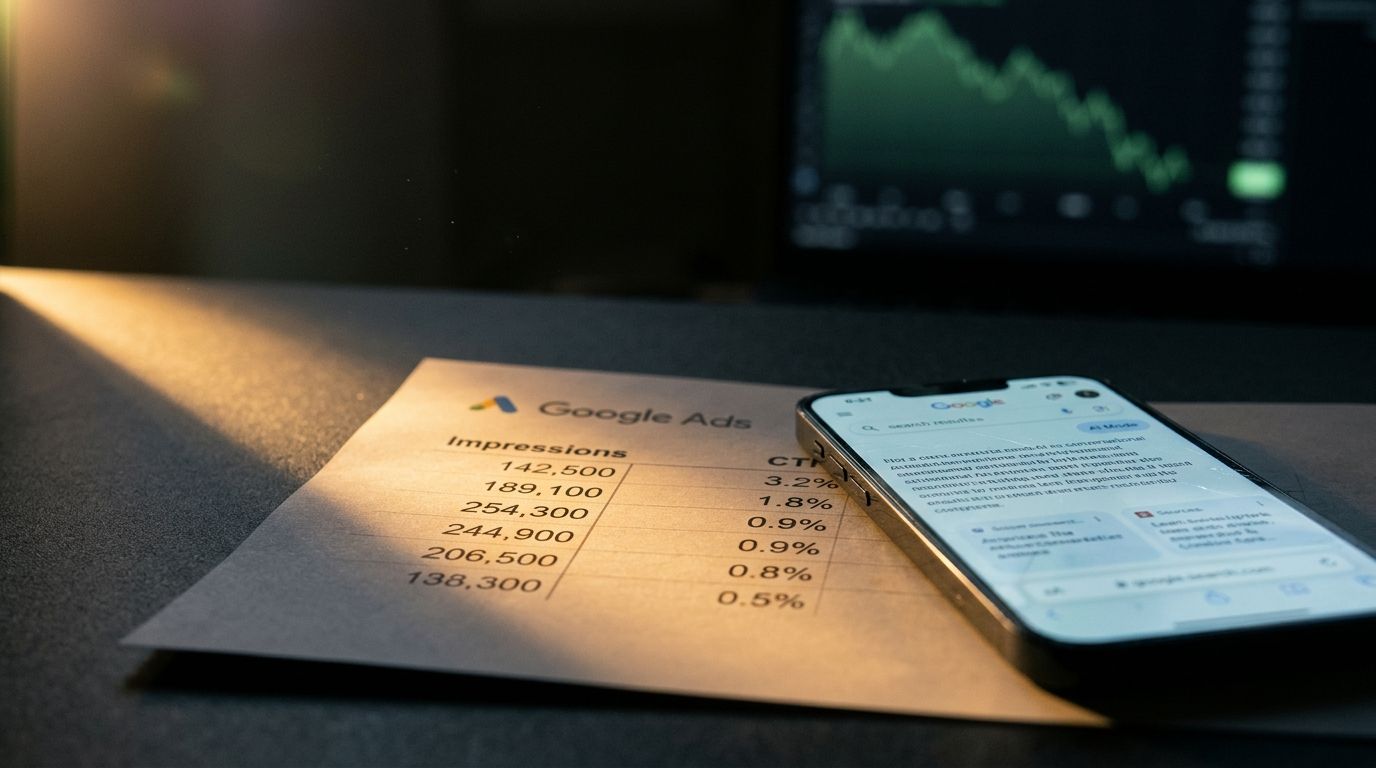
This week, take a hard look at your Google Ads conversion data. Specifically, pull your search impression share and your click-through rate by campaign over the past six months and compare it to the six months before that. If you are seeing more impressions but declining CTR and conversion rates, that is a signal that AI mode is affecting your specific queries right now. Use that data to determine which campaigns to shift budget away from and which to test in new formats as Google rolls out AI mode advertising more broadly.
AI-powered search is not replacing marketing strategy; it is raising the stakes for every business that has been coasting on paid search clicks alone. The businesses that thrive next are the ones building AI into their full marketing operation, not just their ad spend.
Originally inspired by: Google's AI search problem finally shows up in the earnings report, some investors believe (https://the-decoder.com/googles-ai-search-problem-finally-shows-up-in-the-earnings-report-some-investors-believe/)
Your turn
What is your traffic actually doing?
Send us your details and we will come back with a short, specific read on what your traffic, your pages and your pipeline are doing today — and the first three things we would change. A real person reads every submission, and you get the read whether or not we ever work together.